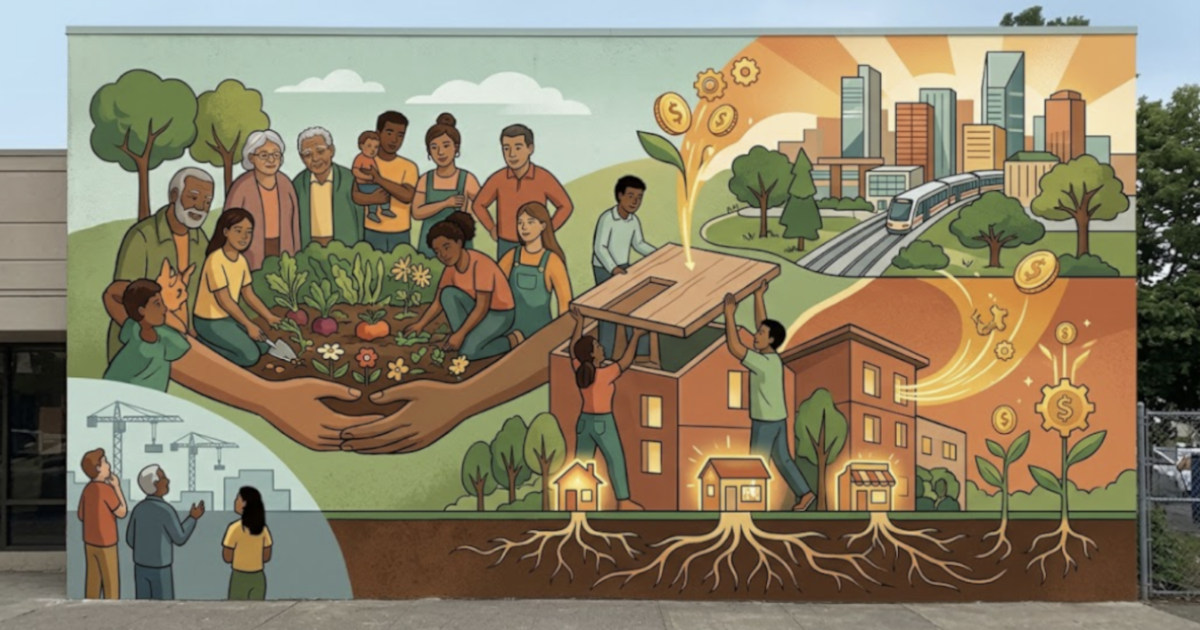
When billions of dollars flow into a neighborhood, the benefits rarely flow evenly to the people who already live there. Community ownership in real estate development offers one way to change that equation by giving existing residents a stake in the assets that appreciate as their neighborhoods grow.
Development creates jobs, housing and tax revenue. Ownership creates something more lasting: an appreciating asset that can continue generating wealth for whoever holds it.
As neighborhoods become more valuable, cities face a question they rarely put on a redevelopment scorecard: Who owns the assets gaining value?
Atlanta’s BeltLine illustrates the gap in stark numbers. Nearly $10 billion in private investment has been catalyzed around the BeltLine. Yet by the end of 2024, according to Urbanize Atlanta, just 250 longtime homeowners were receiving property-tax assistance through the BeltLine’s Legacy Resident Retention Program.
According to Atlanta BeltLine, those homeowners’ properties had appreciated by a combined $10.8 million from the time they entered the program.
The numbers highlight a fundamental challenge in neighborhood redevelopment: investment can make a place more valuable without ensuring that existing residents share in the wealth created. If residents remain primarily renters while outside investors acquire land, housing and commercial property, the economic gains from redevelopment can accrue disproportionately to new owners.
That is the ownership question at the heart of redevelopment: When a neighborhood becomes more valuable, who gets to own the upside?
Three cities show different ways to change that equation — and the limitations of doing so.
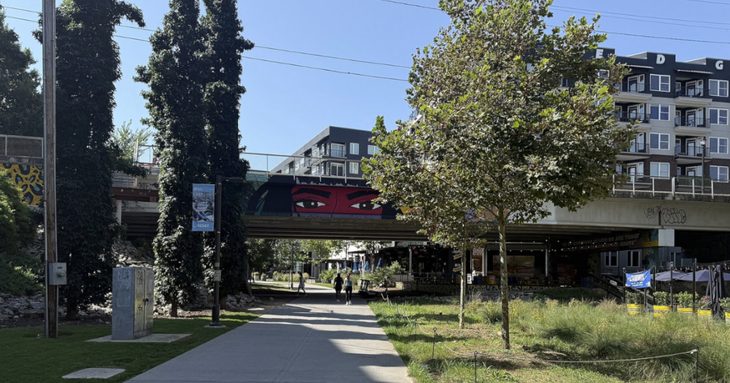
Atlanta: Keeping Owners in Appreciating Homes
Atlanta’s BeltLine illustrates how infrastructure investment can create both opportunity and pressure.
Its Legacy Resident Retention Program, launched in 2020, covers qualifying homeowners’ property-tax increases above their 2019 tax level through 2030. To qualify, residents must meet income and geographic requirements and generally must have owned and occupied their home since before March 2017.
Participants enrolled for at least a year by the end of 2024 saw their homes appreciate by nearly $50,000 on average, according to Atlanta BeltLine. Average property-tax assistance was approximately $2,174 per homeowner.
That distinction matters. The program is not creating the appreciation. It is helping prevent rising property taxes from forcing an owner to sell an asset that is already appreciating.
But scale remains a limitation. BeltLine Partnership leadership estimated in 2025 that nearly 2,000 residents were eligible, compared with 250 homeowners receiving assistance at the end of 2024. The program also relies on philanthropic funding.
Atlanta’s model therefore addresses one specific problem well: preserving ownership that already exists. It does much less for renters who never owned an appreciating asset in the first place.
Portland: Letting Residents Buy into Commercial Real Estate
Portland addresses a different part of the ownership equation.
The East Portland Community Investment Trust allows residents of four surrounding ZIP codes to invest in Plaza 122, a 29,000-square-foot commercial property, rather than limiting ownership to conventional real estate investors.
Since the program launched in 2017, 330 families have invested approximately $648,000, according to the Community Investment Trust. Investors can contribute between $10 and $100 per month after completing a financial education course.
The original $10 share price has increased to $19.65, and investors have received average annual dividends of about 7%. More than $100,000 has been distributed in dividends. The trust also reports that 105 investors who exited have collectively cashed out $237,000, including approximately $108,000 in gains.
Those figures put the returns in better context. This is not a model designed to turn a $10 investment into life-changing wealth. It is designed to give households normally excluded from commercial real estate a low-cost entry point into an income-producing neighborhood asset.
That makes Portland’s model a different approach to community ownership in urban development: rather than protecting an existing homeowner from rising costs, it creates a pathway for residents to become investors in commercial property.
The real estate itself also had to work. Plaza 122’s occupancy increased from 66% in 2014 to more than 90% by 2020 and has remained above that level, according to the trust.
That reveals the challenge of replication: community ownership does not eliminate normal commercial real estate risk. The property still needs tenants, income, management and a financing structure capable of supporting hundreds of small investors.
Boston: Control the Land Before Values Rise
Boston’s Dudley Street Neighborhood Initiative (DSNI) offers the longest-term model — and perhaps the hardest to replicate.
Residents organized DSNI in 1984 after years of disinvestment, vacant property, arson and illegal dumping in Roxbury and North Dorchester. Instead of waiting for private redevelopment, residents drafted their own neighborhood plan and won something almost no resident group ever gets: eminent domain authority from the City of Boston. That power is normally reserved for government. Handing it to a nonprofit let DSNI assemble scattered, blighted, absentee-owned parcels in one sweep, work that would otherwise have taken years of one-off negotiations with owners who had every incentive to hold out.
The resulting community land trust, Dudley Neighbors Inc., holds the land permanently, leasing it out on 99-year terms to the people who live and work on it. It now manages more than 30 acres supporting 226 affordable homes, commercial areas, a community farm, playgrounds and green space, according to DSNI.
The important difference is timing.
Boston’s model secured control of land before redevelopment pressure made acquisition prohibitively expensive. Under the trust, homeowners own their houses but not the ground beneath them. That separation of land value from building value is what keeps homes affordable indefinitely: resale price restrictions travel with the ground lease, not the deed.
For community ownership in real estate development, that timing is critical. Once land values have risen substantially, acquiring enough property to establish community control becomes significantly more difficult.
But that advantage also exposes its limitation. Dudley’s model required extraordinary public authority, patient capital, community organization and decades of stewardship. A developer cannot simply add that structure to a project shortly before construction.
Its lesson is less about copying Boston’s exact model than about recognizing when ownership decisions have to occur.
Community Ownership in Real Estate Development Has to Enter the Capital Stack Early
The three cases solve different problems.
Atlanta helps existing homeowners hold an appreciating asset. Portland creates an entry point into commercial property ownership. Boston removes land from the speculative market and controls its long-term use.
None operates at the scale of the private real estate market surrounding it.
That may be the most important lesson for developers, planners and investors: community ownership in urban development cannot be treated as an affordability program added after redevelopment succeeds.
The cheapest time to create community ownership is before everyone agrees the neighborhood is valuable.
For publicly controlled land, that could mean requiring an ownership or shared-equity component in a development RFP. Cities can identify parcels for community land trusts before infrastructure investments raise nearby values. Commercial projects can explore structures that allow local businesses to purchase their spaces rather than lease indefinitely. Redevelopment plans can identify existing homeowners who may need tax stabilization before assessments begin climbing.
Those decisions affect land disposition, financing and project structure. They belong near the beginning of redevelopment planning, not at the end.
Cities already ask developers how many units they will build, how much private capital they will invest, how many jobs they will create and how much tax revenue a project may generate.
There is another question worth putting into the next RFP: When this project succeeds, who will own part of what becomes more valuable?