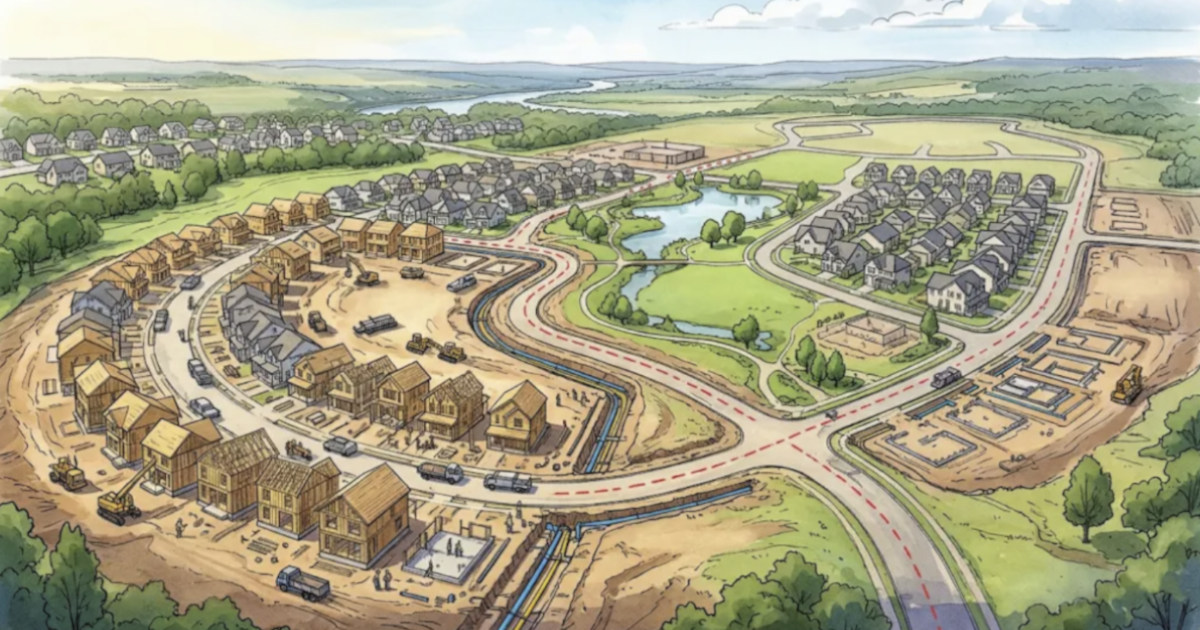
Infrastructure can change a project’s economics before the first home is built. The issue is not simply whether streets, water, sewer and drainage are available. It is whether the project can finance the required improvements and still remain feasible at the rents or home prices the market will support. That makes who pays for infrastructure in new development one of the first questions a project has to answer.
A current Fort Worth example shows the scale. Under the 2026 Northwest Village Community Facilities Agreement, the developer is responsible for about $1.05 million of streets, streetlights and traffic-signal work, plus roughly $93,600 in inspection and testing fees. The agreement expressly says the city is not participating in those costs. That is more than $1.14 million committed to public infrastructure before the project generates most of its development revenue.
At the other end of the financing spectrum, Fort Worth’s Veale Ranch documents show how large infrastructure obligations can ultimately reach individual properties. In one 2026 improvement area, updated Public Improvement District (PID) assessments equal roughly $97,000 to $128,000 per planned dwelling unit, with projected average annual installments of about $7,945 to $10,454, depending on lot type. Those homes are unusually high-value, but the numbers make the central point concrete: infrastructure cost does not disappear. It is allocated.
When the Developer Pays First
Fort Worth generally requires a Community Facilities Agreement, or CFA, when a private development constructs public infrastructure. A CFA can cover water, sewer, paving, drainage, streetlights and traffic signals, and the developer may have to provide a financial guarantee sufficient to ensure completion.
Northwest Village, described above, is a useful example of that front-loaded obligation, but not of one developer subsidizing later projects.
Fort Worth does offer a partial remedy. Under the city’s Water Department Installation Policy and Design Criteria, a developer may be eligible to recover qualifying water or wastewater costs through front-foot charges, water-main capacity charges or wastewater per-acre charges. For example, front-foot reimbursement can apply when a developer extends an approach main beyond its own frontage or installs a qualifying shared frontage main.
So the first developer is not always left carrying every dollar later users benefit from. But recovery covers only qualifying water and wastewater facilities, not roads, drainage, signals or every utility extension a project may build.
When the City Pays for Shared Capacity
Fort Worth uses a different structure when the city deliberately asks for infrastructure larger than one development requires. In June 2019, the City Council approved two agreements for Ventana in southwest Fort Worth.
Ventana itself required a sewer lift station with about 1.7 million gallons per day of capacity. The city wanted a 5.0-million-gallon-per-day station, along with larger gravity and force mains, to serve anticipated future development in the surrounding drainage basin. Fort Worth authorized about $1.66 million for the lift-station work and $1.67 million for the oversized sewer infrastructure. City documents estimated the combined split at roughly 66% city and 34% developer.
Growth did follow. Ventana now describes itself as a more-than-700-acre master-planned community with completed phases and Phase 8 selling. There are 277 residential lots in Ventana Phase 8, with both subphases under construction. That does not measure how much of the extra capacity outside projects now use, but it shows the city’s investment ahead of demand was not stranded.
The principle: the developer pays for the capacity its project requires, while the city can participate in incremental capacity requested for a broader service area. The tradeoff is that public money is committed based partly on expected future growth.
When a District Pays Over Time
Large master-planned developments can shift the timing again. Public Improvement Districts, or PIDs, allow infrastructure costs to be financed and then repaid through assessments on benefited property rather than requiring the entire bill to be absorbed immediately through conventional development financing.
Fort Worth created Rock Creek Ranch PID No. 17 in December 2016. The city later issued $12.685 million of major-improvement bonds and $5.155 million of roadway-improvement bonds.
The homeowner impact is visible in the assessment roll. For a typical single-family lot benefiting from the improvements in fiscal 2026, the major-improvement annual installment was $191.46 and the roadway annual installment was $128.98, about $320.44 for the year combined. The remaining balances owed on that lot were about $1,610.56 and $1,056.18, respectively. Amounts vary by lot and by year, but this is what spreading the bill, rather than eliminating it, looks like.
The structure also does not eliminate developer risk. The service and assessment plan can leave developers responsible for costs that exceed available financing or otherwise fall outside eligible bond proceeds.
Veale Ranch: Layering PID and TIRZ
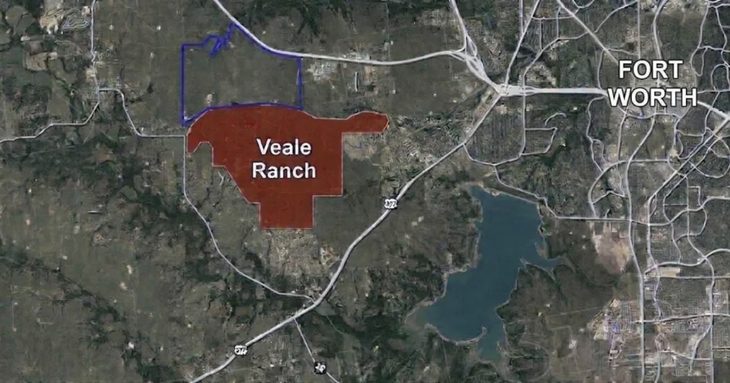
Veale Ranch uses a more layered structure. Fort Worth established PID No. 22 in 2023 for the roughly 5,200-acre development, planned for approximately 6,000 single-family homes, 11 million square feet of multifamily development and 18.5 million square feet of commercial space.
The city also layered on a Tax Increment Reinvestment Zone, or TIRZ, Texas’s version of tax increment financing, designated TIF No. 16 on September 12, 2023. A TIRZ sets aside a share of the new property-tax revenue generated above the zone’s baseline value to pay for eligible costs. Here, the financing plan pledges 65% of the city’s incremental real-property tax revenue within the zone to the TIRZ fund. The current plan estimates approximately $812.5 million of TIRZ project costs and projects about $1.754 billion of incremental tax revenue available for project costs over the plan’s financing period, assuming its growth projections hold.
The PID is being implemented in improvement areas rather than as one single bond issue. In April 2026, the city approved assessments for Improvement Areas 4 and 5. The 2026 Veale Ranch service and assessment plan shows $16.255 million of assessments for Improvement Area 4 and $6.763 million for Improvement Area 5, about $23 million combined.
The TIRZ pays eligible project costs and can offset portions of PID assessments. None of this is free infrastructure. Property can carry PID assessments, future city tax increment is committed to the financing structure, and bond issuance adds interest and administrative costs. The burden is redistributed across time, properties and future value.
Settle Who Pays for Infrastructure in New Development Before Closing
These mechanisms solve different versions of the same financing problem. Developer-funded infrastructure works when improvements primarily serve one project, with targeted cost recovery available for certain shared water and wastewater facilities. City participation can fund incremental capacity the public sector requests for future users. PIDs and TIRZs can spread large infrastructure costs across the properties and future tax base that benefit.
The underwriting mistake is treating infrastructure as something to solve after the land is acquired. Before closing on a development site, the relevant questions are not simply whether water, sewer and roads are nearby. A developer needs to know whether those systems have sufficient capacity, what extensions or upgrades will be required, when the cash must be spent, what portion can be recovered or publicly funded, and what portion ultimately lands in lot prices, rents, assessments or taxes.
That is why who pays for infrastructure in new development is a capital-allocation question as much as an engineering one. The useful calculation is not only the total infrastructure bill. It is how much serves this project, how much creates capacity for the next one, who fronts each portion, and who ultimately repays it.
A road, sewer line or drainage system may eventually serve thousands of residents.
The first developer just happens to need it first.