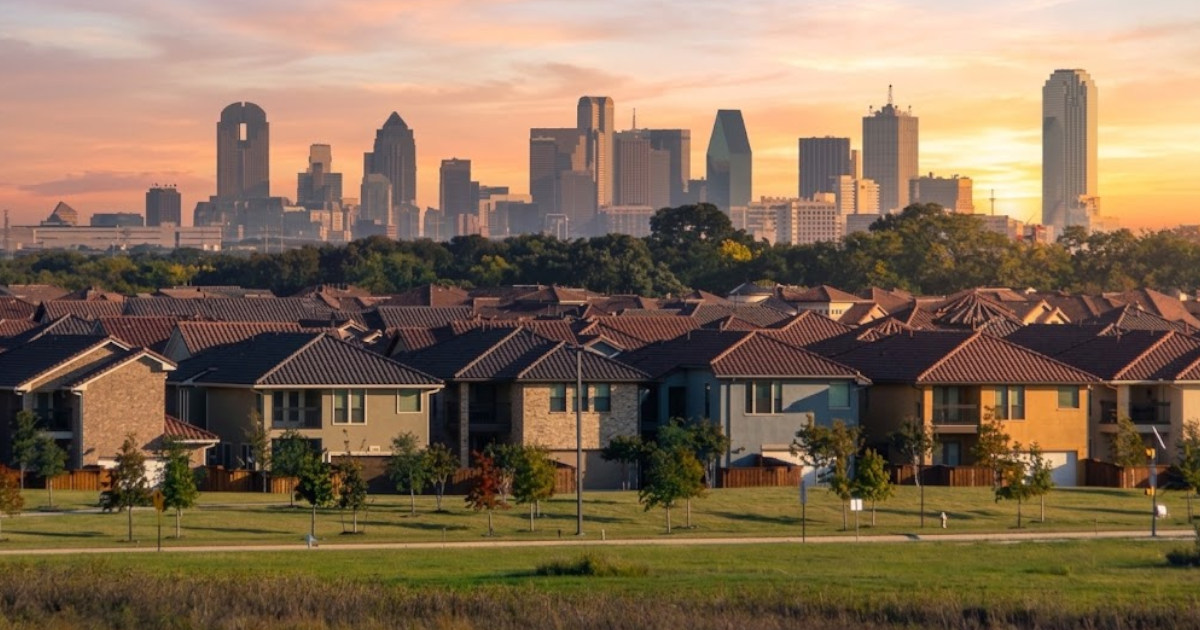
There probably isn’t $100,000 hiding in one line item of a $400,000 Texas house. But there may be enough savings scattered across land, construction, procurement and financing to make the search for a $300,000 new home worth taking seriously.
That search sits at the center of a broader Texas affordable housing debate that’s only getting more urgent as the state keeps growing.
Texas has attracted more new residents from other U.S. states than any other state, making it the nation’s leading destination for domestic migration—and most of them are arriving into a housing market where $400,000 is the new normal.
As of September 2026, Jome.com‘s Texas new-construction database puts the median listing price at over $380,000.
The $300,000 target needs context, too. The National Association of Realtors reported median household income of $97,000 for first-time buyers in its 2024 buyer profile. At a 6% rate on a 30-year mortgage, a $300,000 home with 20% down would carry roughly $1,440 in monthly principal and interest, compared with about $1,920 for a $400,000 home. That nearly $480 monthly difference—before taxes and insurance—can be significant for a household earning approximately $8,000 per month.
Instead of asking only how buyers can finance increasingly expensive houses, builders and housing organizations are testing whether the house itself can be produced differently.
A $400,000 House Is a Collection of Costs
Break a $400,000 house into its parts, and the price stops looking like one problem and starts looking like several.
The National Association of Home Builders’ 2024 Cost of Construction Survey found that construction accounted for 64.4% of the average new home’s final sales price. The finished lot represented 13.7%, builder profit 11%, overhead 5.7%, sales commissions 2.8%, financing 1.5%, and marketing 0.8%.
Those are national averages, not a Texas-specific cost model. But they reveal multiple places where Texas affordability housing experiments can reduce the final price.
Texas Is Changing the Economics of the Lot
One way to make housing more affordable is to fit more homes onto the land already being developed.
Texas Senate Bill 15, effective September 1, 2025, prohibits certain larger municipalities from requiring residential lots larger than 3,000 square feet for qualifying developments and caps several related dimensional requirements. The important number isn’t 3,000 square feet. It’s homes per acre.
More homes on the same tract can distribute acquisition and infrastructure costs across additional units. The policy doesn’t guarantee lower prices—developers can retain some savings, and smaller lots will not appeal to every buyer—but it gives builders another lever when trying to make entry-level housing pencil.
It’s not the only lever, either. Some homeowners are pursuing the same math on a smaller scale by adding accessory dwelling units to lots that already have a home on them.

New Construction Is Already Being Redesigned for Price
The Texas Real Estate Research Center reported in May 2026 that builders are strategically shifting toward smaller homes as affordability pressures reshape demand.
Before the pandemic, new homes often carried premiums approaching $100,000 over resales. By March 2026, the median new-construction sales price was $341,500, compared with $326,200 for existing homes—a gap of only $15,300.
That narrowing suggests builders are responding to a buyer increasingly unable, or unwilling, to pay a substantial premium simply because a home is new.
South Texas Turns Homebuilding Into a Production System
Come Dream, Come Build (CDCB), a South Texas nonprofit housing developer, discovered that modular construction isn’t inherently cheaper.
According to the National Institute of Standards and Technology, CDCB’s first 576-square-foot modular prototype, built in 2022, cost more than $150,000, or roughly $260 per square foot—$110 per square foot over budget.
Instead of abandoning the concept, CDCB worked with the Texas Manufacturing Assistance Center to rethink production using bills of materials, mapped procurement, organized staging areas, lean manufacturing, and formal quality controls.
NIST reports that the resulting DreamBuild operation reduced build cost per square foot by 45%.
The lesson wasn’t that modular building guarantees lower costs. Savings appeared after the organization began treating housing production as an adaptable operating system.
Houston Is Testing the Value of Time
Houston Habitat for Humanity is testing another version of the concept.
According to a 2026 Houston Chronicle report, its 1,600-square-foot modular homes cost approximately $218,400, compared with $227,625 using traditional construction.
The direct savings are modest compared with a $100,000 affordability gap. The construction schedule may be more consequential.
A traditional Habitat house takes approximately four to six months to build. The modular version spends about two months in factory production followed by six weeks of onsite finishing.
For developers using borrowed capital, time is itself a construction expense. Acquisition, development and construction financing continue accumulating until homes are completed and sold.
Houston Habitat expects its modular homes to sell for approximately $230,000 to $253,000 and plans over 20 additional units in Southwest Houston.
Industrialized Construction Is Attracting Financial Attention
A June 2026 JPMorganChase PolicyCenter analysis estimates manufactured, modular, panelized, and other industrialized construction methods can reduce construction costs by 20% to 30% and timelines by 30% to 50%.
Those estimates come with limits. Factory construction doesn’t eliminate land, foundations, utilities, transportation, permitting, or financing. CDCB’s expensive first prototype demonstrates that off-site construction alone isn’t a shortcut to affordability.
The opportunity appears to be in combining technology with disciplined procurement, repeatable designs, predictable labor, and volume.
Texas Affordable Housing: The $300,000 House Is a Math Problem
No single experiment proves that every $400,000 Texas home can become a $300,000 home.
What the examples demonstrate is that affordability can be attacked at multiple points before a buyer ever applies for a mortgage. Lot reform changes land utilization. Builder redesign narrows the new-home premium. Industrialized construction targets production time, labor, and waste. Manufacturing principles change procurement and workflow.
There is no single $100,000 silver bullet.The more practical question is how much cost can be removed, compressed, or avoided across the entire development process—and how much of those savings ultimately reaches the buyer.