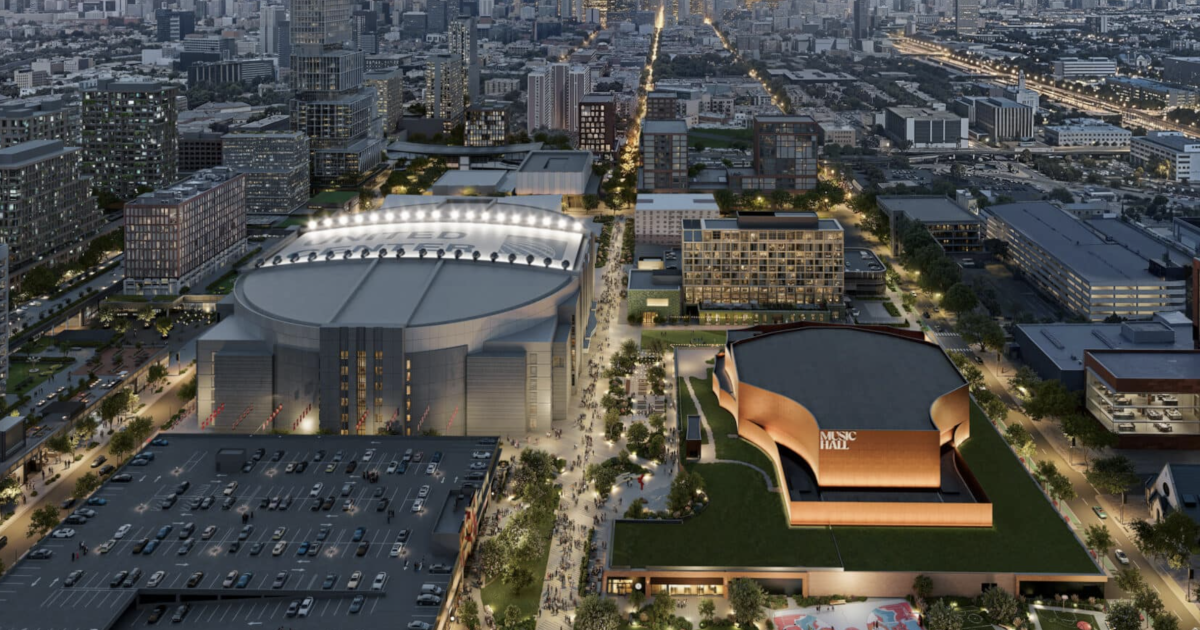
For most of its life, Chicago’s United Center has been a fortress. The Chicago Bulls and Blackhawks built one of the most successful arenas in the country, then ringed it with 55 acres of surface parking lots that sat half-empty on most days and completely empty on the other 300. That’s the standard deal in sports real estate: the venue is the destination, and everything else is spillover.
In June 2026, the ownership behind the Bulls and Blackhawks — the Reinsdorf and Wirtz families — broke ground on something considerably more ambitious. The 1901 Project, named for the United Center’s address on West Madison Street, is a $7 billion, multi-phase development that would transform those parking lots into a 13-million-square-foot mixed-use district integrating housing, hotels, offices, retail, parks, and a new music hall. It is the largest private investment in Chicago’s West Side, and if it executes, it will be one of the most consequential case studies in sports real estate.
What Does The 1901 Project Actually Plan to Build?
At full build-out, The 1901 Project would deliver approximately 9,500 residential units — with 20% designated affordable, producing roughly 1,900 below-market homes — alongside 1,309 hotel keys, 25 acres of public parks and open space, and extensive retail and office corridors. The master plan was designed by RIOS, with landscape architecture by Field Operations, the firm behind New York City’s High Line.
What does The 1901 Project mean for Chicago’s West Side? It means converting 55 acres of car infrastructure into a dense urban neighborhood anchored by an existing arena. The United Center stays; the dead zone around it does not. The project also includes a push for a new CTA Pink Line station on Paulina Street, a move that would stitch the Near West Side back into the city’s transit grid for the first time in decades.
Phase one, currently underway with a targeted completion of 2028, is valued at $500 million. Its centerpiece is a 6,000-seat music hall projected to host 150 events annually, alongside a 180-key boutique hotel, retail space, and two parking garages topped with rooftop green space. The Chicago City Council unanimously approved the project in early 2025 — an unusually clean approval for a development of this scale — and subsequently approved a $55 million property tax break for phase one.
Three Generations of Sports Real Estate — and Why Gen 2 Ran Out of Road
To understand what The 1901 Project is proposing, it helps to trace what came before it.
The first generation of sports real estate was blunt: build the stadium, pour the asphalt, wait for the city to grow around it. Old Candlestick Park in San Francisco is the defining example, an isolated island that generated foot traffic twice a week and sat dormant the rest of the year. The original United Center followed the same logic.
The second generation arrived in the 2010s and is best represented by The Battery Atlanta, built by the Atlanta Braves around Truist Park. That project proved that team ownership and real estate development could work as a single business: by controlling the surrounding 60 acres, the Braves built offices, a Comcast regional headquarters, an Omni hotel, and apartments, producing year-round revenue completely decoupled from ticket sales. It became the model that every franchise with excess land has since tried to replicate.
The problem is that The Battery, like most of its successors, is essentially a suburban lifestyle center transplanted near an arena. Polished, managed, and financially successful, but closed off from the city fabric around it, built for corporate and fan spend rather than for residents, and reliant on commercial entertainment rather than civic infrastructure.

Why The 1901 Project Advances the Sports-Anchored Urban Development Model Further
The 1901 Project doesn’t reject the second generation; it corrects it. The differences are structural, not cosmetic.
Density at a Scale That Produces an Actual Neighborhood
Most sports districts treat housing as a premium amenity — a few hundred luxury units that add a residential veneer to what is functionally a commercial campus. The 1901 Project is targeting nearly 10,000 residential units. That’s not a gesture toward neighborhood-building; it’s the foundation of one. At that volume, the district generates its own daily demand for grocery stores, schools, and services, the ecosystem that makes a neighborhood self-sustaining rather than dependent on event-day traffic.
Infrastructure Hidden, Parks Built on Top of It
Surface parking lots were the original sin of the first-generation arena model. The 1901 Project compresses parking vertically into structured garages and places 25 acres of public park space on top of and around them. Infrastructure traditionally treated as an eyesore becomes the physical substrate for a green network engineered to combat the urban heat island effect. It’s the same logic as New York’s High Line, applied at a neighborhood scale.
Private Capital Absorbing the Risk of Sports Real Estate Development
Sports-anchored urban development projects have historically depended on public subsidy. Cities absorbed the risk of stadium construction through Tax Increment Financing districts, tax abatements, and direct spending, with the promise that spillover development would eventually generate returns. The 1901 Project inverts this. The $7 billion commitment is private, and the Reinsdorf and Wirtz families are absorbing the development risk directly, which changes the accountability dynamic significantly: the project’s success is tied to their own capital, not to public patience. The Class 7b tax break for phase one is real public support, but it’s a property tax incentive on a privately funded project, not a stadium subsidy.
Affordable Housing at a Proportion That’s Unprecedented in This Context
A 20% affordable housing commitment on a private sports-anchored development is unusual. The 1,900 affordable units proposed here are designed to prevent long-time West Side residents from being displaced by the investment they’ve been waiting for, a tension that has plagued similar projects elsewhere. Whether the commitment holds through all seven phases is an open question, but the mandate is written into the project’s structure rather than offered as a voluntary gesture.
What Still Has to Come Together
The 1901 Project has moved fast by Chicago standards: unveiled in July 2024, approved unanimously in February 2025, broken ground in June 2026. But the seven-phase build-out will span well over a decade, and several significant elements remain unresolved.
The proposed Pink Line station on Paulina Street — arguably the most important piece of civic infrastructure in the entire plan — is still being negotiated between the project team and the city. Transit access isn’t incidental to The 1901 Project’s success; it’s what separates a dense neighborhood from a well-designed island. Without it, the West Side residents the project is meant to serve are still one long walk from the grid.
What Does the 1901 Project Mean for Every City With an Aging Arena?
The 1901 Project isn’t proposing a new type of arena. It’s proposing a new relationship between a sports franchise and the city it occupies. The Reinsdorf and Wirtz families have operated in Chicago for generations. That permanence is what makes the long-term commitment credible in a way that a franchise relocating to a new market and building a lifestyle district around a new stadium simply isn’t.
If it executes across all phases, The 1901 Project becomes the reference case for what sports real estate can be in a mature market: not a district built for fans on game days, but a neighborhood built around an arena that was already there. That’s a harder problem to solve than building fresh in a suburb, and solving it changes what every city with an aging arena surrounded by parking lots now has to consider.