Your weekly look at the projects, deals, and policies remaking the built world.
You Should Know
- Spain is facing one of the world’s most hotly debated housing crunches, with rents nearly doubling in a decade. After a televised eviction of an 87-year-old Madrid woman sparked protests, the prime minister’s government issued emergency decrees extending eviction bans and automatically renewing leases. Parliament subsequently rejected both, and the woman has since passed away. Protests continue.
- America’s heartland generates more than a third of U.S. GDP but attracts only about 10% of venture capital, according to a new McKinsey and Heartland Forward report. Closing that gap, especially in the region’s 300-plus small “micropolitan” cities, could add up to $2 trillion in economic output.
- Inrix’s new Parking Scorecard of 120+ downtowns shows North American drivers find street parking more often than Europeans (59% vs. 41%) but pay more than twice as much for garages ($8.35 vs. $3.88 an hour). New York has the priciest garages overall, and London, the priciest street parking in Europe.
Worth Watching
- One company built a $10B city outside Baghdad.
- The logistics of NYC waste management.
- China is building a $100B city to take pressure off Beijing.
Top Stories
Universities Are Turning Their Campuses into Energy Infrastructure
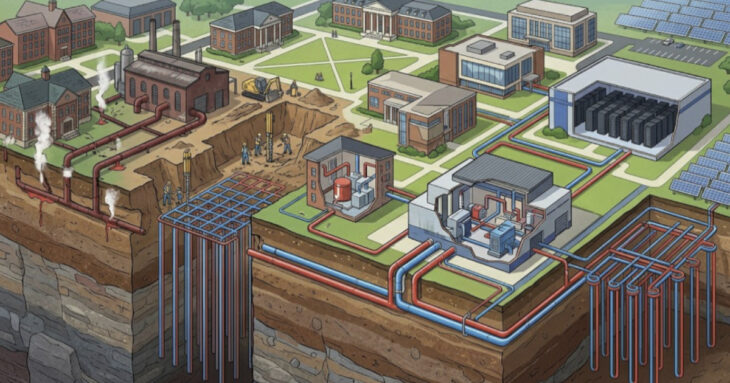
For a century, most American universities heated buildings by burning fuel in a central plant and piping steam underground. That model is now being dismantled, and its replacements look less like campus utilities and more like prototypes for the thermal energy networks cities will need.
Thermal energy networks link buildings through underground water loops tied to a shared heat source, such as geothermal boreholes, surface water or industrial waste heat. Central heat pumps and exchangers move energy between buildings and the ground, so buildings with surplus heat can pass it to those that need it.
Princeton University shows the scale involved. Its steam system dates to the 1860s, and the university estimates at least 30% of its plant’s heat is lost through aging pipes. It is now drilling more than 2,000 geo-exchange bores up to 850 feet deep and laying over 13 miles of new piping, and its TIGER plant is already operating.
Princeton expects it will take about 20 years to reach every building with the full hot-water conversion. More than 180 buildings need their mechanical systems converted, and steam equipment keeps running alongside the new systems until each switch is made. The target is net-zero campus emissions by 2046.
At the University at Buffalo, the heat source is a supercomputer. A $62 million state-funded project with the New York Power Authority will capture waste heat from the Empire AI supercomputing center to warm the North Campus.
Detailed plans were announced in early 2026. The work will decarbonize the campus central utility plant by building two 30-inch neutral-temperature water pipes that connect it to the Empire AI center. The plant will get new heat exchangers and electric heat pumps, and geothermal wells next to the UB Solar Strand will help distribute the heat.
Northeastern University is planning a campus-wide thermal energy network in Boston that would replace steam infrastructure with a water-based system connecting buildings across three districts. The NU-TEN system would use heat pumps to capture waste heat from buildings that require cooling and redirect it to buildings that need heating.
The plan is particularly notable for its vision of a thermal energy network in which buildings become interconnected energy assets rather than simply customers of a central plant. NU-TEN is in the early implementation phase, with construction expected to proceed in stages over many years.
Universities have always been small cities. Now, campuses are acting as their own utilities, with the land, long time horizons and research staff to test systems that cities cannot yet risk.
Texas’s Southern Tip Becomes a $40B Megaproject Hub
Cameron County, the southernmost county of Texas, has assembled one of the most concentrated pipelines of industrial investment in the country.
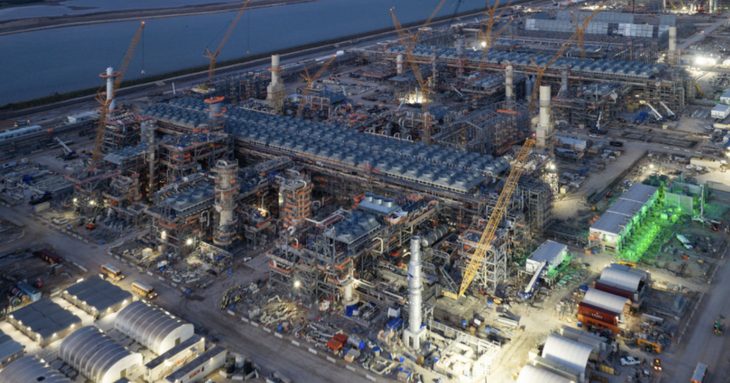
Four projects, three at the Port of Brownsville and one at Boca Chica Beach, carry a combined estimated investment of more than $40 billion. Together they span liquefied natural gas (LNG) exports, commercial spaceflight and autonomous naval manufacturing, a mix few regions of any size can match.
Why are these megaprojects concentrated in Cameron County? The region offers something few places on the U.S. coast still have: large tracts of flat, open land directly on deep water, far from dense population.
Texas’s business-friendly permitting and tax climate, along with lower land and labor costs than other coastal regions, add to the appeal. A cluster effect is also taking hold, as each project strengthens the case for the next and builds a specialized workforce and infrastructure base that compounds over time.
Rio Grande LNG is by far the largest. Developed by NextDecade Corporation, the natural gas liquefaction and export terminal accounts for an estimated $31.8 billion and covers roughly 1,000 acres at the port. The county ranks it among the biggest energy infrastructure investments in Texas history. Bechtel is building five liquefaction trains with a combined capacity of about 30 million metric tons per year, and the site has room for up to 10.
SpaceX’s Starbase and launch facility carries an estimated $3.5 billion investment. Boca Chica is the company’s main site for developing, testing and building Starship. The county credits Starbase with $13.5 billion in economic impact and expects a 700,000-square-foot vertical integration manufacturing plant to be completed around late 2026.
Texas LNG brings a second export terminal to the port, with an estimated $2.8 billion investment on a 625-acre site. Developed by Glenfarne with Kiewit as construction contractor, the 4 million metric ton per year terminal is targeting commercial operations in 2031.
The newest entrant may prove the most transformative. Saronic Technologies chose Brownsville for Port Alpha, a $3 billion autonomous naval shipyard, after a year-long national site search. Starting on 835 acres with room to grow to nearly 4,400, the yard will build vessels up to 850 feet long and eventually more than 1,200 feet. Operations are expected in 2028. Saronic projects up to 10,000 direct jobs and more than $160 billion in regional economic impact.
Manufactured Housing Gets Its Biggest Rewrite in 50 Years
U.S. regulators are rewriting the rules for manufactured housing in a bid to spark a renaissance in affordable home construction.
The historic 21st Century ROAD to Housing Act, which became law in July, ended the requirement that manufactured homes be built on a permanent steel chassis. The rule dated to the 1970s and added as much as $10,000 to the cost of each unit. It was part of the HUD Code, formally the Manufactured Housing Construction and Safety Standards, the national building code every manufactured home in the U.S. must meet.
A chassis is the steel frame built into the base of a manufactured home so it can be moved from the factory to its site, where it then stays permanently. Yet most manufactured homes never leave their first site. The requirement has also been tied in part to the industry’s decline in production since its heyday in the 1970s and 1980s.
Removing the chassis has ripple effects across the code. Its rules for a home’s structure, lifting, transportation, connections, anchoring and foundation all assumed a steel frame underneath. HUD now has to rewrite them for homes without one.
“Removing the permanent chassis requirement is more than a technical change,” said Joe Gormley, acting assistant secretary for the Federal Housing Administration. “It creates an opportunity to reconsider how manufactured homes are designed, transported, assembled, and regulated, so we can increase supply for first-time homebuyers.”
HUD’s response is the Next Generation Manufactured Housing Action Plan, released Oct. 7, 50 years after the HUD Code was created. The seven-part plan sets new engineering standards for chassis-free homes. They cover structural design, lifting, transportation and how sections connect, along with foundations, anchoring and setting.
The plan also creates an “on-ramp” for modular and off-site builders. HUD will give these manufacturers guidance on factory certification, design approval and quality assurance so they can join the federal system. The goal is to reduce “barriers to entry,” which could increase the number of companies producing HUD-regulated homes.
In a bigger leap, the HUD Code could extend to apartment buildings. HUD plans a performance-based construction and safety code for residential buildings with five or more units. It would address issues current standards don’t fully cover, such as fire separation, accessibility, stairs, common areas and shared systems. HUD says this “could create a national pathway for repeatable multifamily construction under a consistent federal regulatory framework.”

The Turnaround Plan for NYC’s Iconic Chrysler Building
Nearly a century after it briefly stood as the world’s tallest building, the Chrysler Building is getting a second life.
Tishman Speyer has taken over the 77-story Art Deco landmark and will invest $235 million to restore and modernize it, ending more than a year of uncertainty over the tower’s future. The firm signed a 150-year ground lease with Cooper Union, the private college that has owned the land beneath the building since 1902.
The tower has fallen far from its glory days. By 2024, tenants were reporting cracked ceilings and rodents in the ground-floor retail space, and today about half the building is vacant.
That makes Tishman Speyer’s plan to reposition it as a boutique office tower a revealing look at how a developer goes about reviving an iconic but neglected building.
The turnaround starts with the finances, which drove the tower’s decline as much as its physical condition did. Rising ground rent and competition from newer buildings drove the tower’s value down so far that Signa and RFR paid only about $150 million for it in 2019. Insolvency and eviction followed. This time, Tishman Speyer and its partners are bringing patient capital, funding the project with 100% equity.
The timing also favors renovation. Tishman Speyer argues that the economics of new development simply don’t pencil out right now, and it points out that almost no new office space has been built around Grand Central in decades.
The work on the 1.3 million-square-foot building includes restoring the facade, polishing the stainless steel crown and overhauling the elevator, mechanical, electrical and air-handling systems. Because of the building’s landmark status, many of its public spaces must be preserved.
Speed is central to the strategy. At least 75% of the vacant space will be prebuilt as move-in-ready suites for smaller companies, a bet that the market is full of tenants who need space fast. The plan also adds a 61st-floor clubhouse with a terrace, along with wellness services below the lobby. Both follow the playbook the firm used at 30 Rockefeller Plaza, where it carried out a $75 million revamp of the observation roof and added new dining and retail underground.
For Tishman Speyer, which first bought the Chrysler Building in 1997, the deal is a return to a building it once owned. It is also a test of whether rethinking the lease, funding without debt and offering ready-to-use space can revive other aging Manhattan towers.
Big Deals
- U.S. Dept. of Homeland Security pays $950M to buy California ICE detention centers.
- Emera and Canadian Utilities merge in $10B deal, forming $50B utility giant.
- Federal Realty pays $508M for Alabama’s most-visited retail destination.
- Grenergy obtains $457M for Chile solar and storage projects.
- BDT & MSD Partners buys a majority stake in a luxury senior-housing company at a $1B valuation.
- Greystone provides $167M in financing for Miami affordable housing project.
- CiviSmart, an Italian smart public lighting platform, secures up to €120M in financing.
- Type One Energy raises $200M to build a fusion power plant.
- Hines acquires a nine-property mixed-use portfolio in Dallas for $171M.
- Parallel Systems lands $100M to fully commercialize its autonomous freight rail system.
- Terra-led JV obtains $507M construction loan for Miami Beach condo ahead of sales.
- Vivek Ramaswamy’s nuclear startup Atlas Atomics raises about $400M.
Extra Reads
- Anduril and the U.S. Navy plan a $6.6B submarine shipyard.
- France’s Sesterce plans an $11B AI data center investment in Finland.
- Google and Constellation agree to bring 890 MW of new nuclear capacity to the PJM grid.
- Bayer plans a $2.2B pharmaceutical manufacturing site in Ohio.
- Charlotte launches a public on-demand rideshare service for $2.20 per ride.
- Chinese contractors begin a $2.5B rail construction project in Jordan.
- South Bay, CA, transit workers get housing preference on transit-owned land to ease commutes.
- Brookfield launches a UK affordable housing drive.
- Bangkok plans at least $3B in flood defenses over 5-7 years.
- South African utility Eskom seeks partners for up to 6 GW of renewable energy and battery projects.
- Blue Energy seeks the first ERCOT grid connection for small modular nuclear reactors.
- Saudi Arabia gets a new real estate developer with a $4.3B pipeline.