Here’s our latest round-up of news and insights about the future of cities and urban development.
You Should Know
- PJM, the largest U.S. grid operator, saw its latest capacity auction close at $16.4B for June 2028 power, with data center demand pushing supply costs up more than 60% and leaving the grid roughly 6.8 GW short of its reliability target for a third straight auction. PJM will need to raise billions from ratepayers, likely driving up electric bills.
- China is prepping a $295B plan to fund a nationwide AI buildout.
- New York became the first state to halt data center construction after Gov. Kathy Hochul signed an executive order temporarily barring permits for new projects of 50 megawatts or larger.
- The Global Public Toilet Index ranks cities by per capita public restrooms. Chiang Mai, Thailand, tops the list. Three Swiss cities—Bern, Basel and Zurich—take second, third and fourth. Salt Lake City is fifth. Among major U.S. cities, New York is #34, L.A. is #45, and Chicago is #35.
Worth Watching
- Why Amtrak can’t turn a profit.
- Chengdu built the largest building on Earth by floor area and put a beach inside of it.
- Why do some countries only have one big city?
Top Stories

Disney’s Bet on Real Estate Storytelling
Disney’s residential real estate venture, Storyliving by Disney, is now in motion on two coasts, with its first community welcoming residents in California and its second breaking ground in North Carolina. The venture offers an interesting case study in how popular companies can extend their brands into residential real estate.
Disney doesn’t own the land at its Storyliving communities. Instead, it partners with outside developers and builders, while Disney’s role is to shape each community’s story through Walt Disney Imagineering. The idea is to root each neighborhood in local culture and tradition, then inject Disney style and programming into shared community spaces.
Disney likely earns licensing royalties from developers on home sales, though where it profits most directly is through the amenities. Disney builds, owns and operates the club facilities within its communities, charging a substantial initiation fee plus annual dues that can add up to tens of thousands of dollars over time.
Cotino, the first Storyliving community, sits on 618 acres in Rancho Mirage, California, near Palm Springs. The first residents, dubbed “pioneers” by Cotino officials, began moving in during April 2025. The project has city approval for roughly 1,900 homes and condos, with an initial phase of about 300 homes. Numerous homes have already been sold, with prices ranging from about $1.3 million to more than $4 million. Homebuilders include Davidson Communities, Shea Homes and Woodbridge Pacific Group.
Residents can join the optional Artisan Club for a $20,000 initiation fee plus $11,000 in annual dues, which grants access to the 24-acre Cotino Bay lagoon, a restaurant, a wellness center and the Incredibles-inspired Parr House. A town center called Cotino Bay Beach, Dining and Shops is expected to open in fall 2026.
Disney’s second community, Asteria, is under construction in Chatham Park, part of Pittsboro, North Carolina, just outside Raleigh, in partnership with DMB Development. The roughly 1,500-acre site is planned for more than 4,000 residential units, including options for residents 55 and older.
The first phase includes a Discovery Studio, model homes, community parks and trails, 300 home sites, and the Second Star Club, a members-only gathering space named for the Peter Pan reference to Never Land. The club will feature Marquet Hall, a two-story restaurant; the Piedmont Proper event pavilion; creative studios for woodworking and quilting; and a wellness center. Programming will span enrichment workshops, entertainment, wellness activities and excursions.
Home sales at Asteria are anticipated to begin in fall 2027, with residents expected to move in by fall 2028.
America’s Solar Plants Finally Join the Gigawatt Club
For more than a decade, the benchmark for utility-scale solar in the United States was Solar Star in Rosamond, California, with a capacity of 579 MW. Opened in 2013, the plant briefly held the title of the world’s largest solar farm by capacity, and for years its scale seemed untouchable, at least in the U.S.
Solar Star was surpassed in 2024 by the 690 MW Gemini Solar Project in Nevada, which was in turn surpassed in 2026 by Repsol’s 825 MW Pinnington Solar in Texas. None of these plants, for all their records, ever crossed the one-gigawatt threshold. That’s finally changing.
Last week, Cypress Creek Energy and Google broke ground on a solar project that will dwarf all these plants and become the largest solar plant in America: the Steel River Energy Center in Mississippi County, Arkansas. The first two phases will add 1.6 GW of solar capacity and 1.9 GWh of battery storage to the regional grid. Once complete in 2029, the full project will reach 2.5 GW of capacity and 2.9 GWh of storage, enough to power more than 315,000 Arkansas homes annually.
Google secured power from the first two phases through a PPA with Cypress Creek. Construction is expected to create roughly 700 jobs per phase and generate an estimated $300 million in local tax revenue over the project’s lifetime.
A similarly concentrated buildout is taking shape in Arizona’s La Paz County, where Hanwha Qcells is EPC contractor for Atlas Energy Park: 14 integrated solar and storage projects across roughly 63.7 square kilometers, delivering 2.8 GW of solar capacity and 5.7 GWh of storage by 2028. Power from completed phases has been contracted by Southern California Edison. La Paz County’s flat desert terrain and direct access to Southern California and Southwest transmission lines have made it one of the nation’s busiest solar corridors.
Indiana tells a similar story, built through gradual expansion rather than one megaproject. Mammoth Solar, developed by Doral Renewables across 13,000 acres in Pulaski and Starke counties, will reach 1.6 GW at full build-out, powering approximately 275,000 homes and lifting Indiana’s total solar capacity by more than 20%.
Even so, the gap with China remains substantial. China’s Talatan solar complex in Qinghai Province was reported at roughly 21 GW in 2026, nearly ten times Steel River’s planned full build-out. China is also expanding further, including an 8 GW Inner Mongolia project from Three Gorges Renewables expected online by 2027. By the end of 2025, China’s total installed solar capacity reached approximately 1,200 GW. U.S. projects are growing quickly, but still at a fraction of China’s scale.
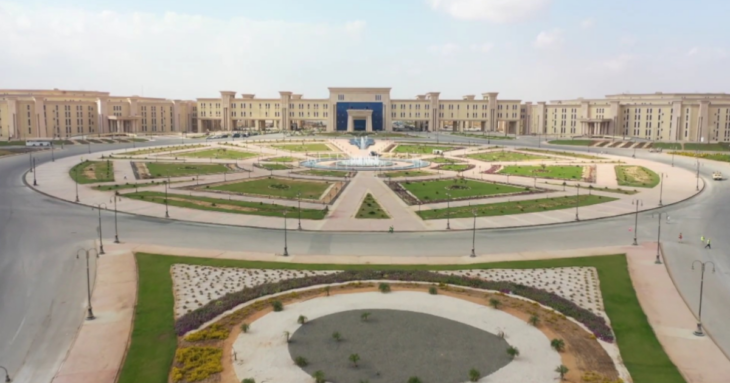
Military Command Cities: The New Scale of Defense Infrastructure
Among a growing set of geopolitically ambitious states, militaries are moving away from single command buildings toward sprawling, fortified command cities that combine administration, communications, and crisis management in one secure campus.
Egypt’s newly inaugurated “Octagon” and a Chinese complex under construction outside Beijing are two of the most striking examples.
Despite their different designs and purposes, both projects share core features: massive scale that dwarfs the Pentagon, integration of AI for data analysis and decision-making, closed communication networks isolated from the public internet, and a stated goal of ensuring uninterrupted command continuity during crises or war.
Egypt’s Octagon, the $57 billion Ministry of Defense headquarters in the New Administrative Capital east of Cairo, spans a footprint reported at over 92 square kilometers by some military assessments, with roughly 50.5 million square feet of floor area — about 7.7 times the Pentagon’s 6.6 million square feet. The complex comprises eight octagon-shaped buildings representing the branches of the Egyptian Armed Forces, built with reinforced concrete and organized into 13 zones and six specialized centers. Analysts have described the complex as an engineering and architectural marvel, praising its fusion of Pharaonic design with modern military engineering.
The Octagon is part of a larger establishment that includes worship venues, clubs, hotels, schools, playgrounds, residential projects, shopping malls, hospitals, and complexes for civil and administrative services. Two Republican Guard units, along with other security measures, protect the site.
China’s project, referred to in intelligence circles as “Beijing Military City,” is being built roughly 30 kilometers southwest of Beijing and covers about 1,500 acres, or 7.4 square kilometers.
Unlike the Octagon’s above-ground administrative design, the Chinese site emphasizes fortification, with satellite imagery reportedly showing deeply buried bunkers intended to withstand nuclear or bunker-buster strikes and to preserve high command functions during wartime. Analysts describe it as part of a broader modernization push tied to integrating operations across land, sea, air, space, and cyber domains, under strict secrecy and heavy security.
Both facilities are also said to rely on early-warning and simulation systems, along with jamming capabilities, to defend against external threats and to keep operations shielded from foreign surveillance.

$100B More from TSMC Fuels Phoenix’s Boom
Phoenix is getting another jaw-dropping injection of money from Taiwan Semiconductor Manufacturing Company (TSMC). The company is adding another $100 billion to its Arizona operations, bringing its total investment in the state to $265 billion — what officials call the largest foreign direct investment in U.S. history.
The scale is striking simply because of how fast it grew: TSMC’s Arizona commitment went from $65 billion in 2024, to $165 billion in 2025, to $265 billion now — roughly quadrupling in about two years. That investment now exceeds Arizona’s entire annual state government budget by more than 2-to-1.
TSMC says the new funding will finance four additional fabs producing chips at 2-nanometer or more advanced process nodes, built on roughly 900 acres near its existing north Phoenix campus. Combined with facilities already underway, the buildout brings TSMC’s Arizona footprint to 10 fabs, two advanced packaging facilities, and a research and development center, with about 30% of the company’s global capacity for its most advanced chips expected to sit in Arizona once complete.
The company says the investment reflects sustained multi-year demand from major U.S. customers, including Nvidia, and is meant to strengthen the domestic chip supply chain.
That scale of investment is reshaping the ground around TSMC’s campus. Construction began earlier this year on Halo Vista, a $7 billion, 2,300-acre mixed-use development built immediately adjacent to the semiconductor complex. Co-developed by Mack Real Estate Group (MREG) and McCourt Partners, Halo Vista is designed as a “city within a city” to support the workforce and supply chain TSMC’s growth is drawing in.
At full buildout, Halo Vista will span nearly 30 million square feet of industrial, office, retail, residential, educational, and hospitality space, including up to 9,000 residential units. First-phase tenants include a Costco, an 11-parcel auto mall, and a dual-branded Marriott with Courtyard and Residence Inn properties, positioned along Interstate 17 and Loop 303 for regional access.
MREG says research trips to Taiwan’s Hsinchu Science Park shaped the Halo Vista plan around the idea of an “ecosystem” — supplier sites, visitor hotels, employee housing, healthcare, and education, potentially including a partnership with Arizona State University. The full buildout is expected to take 15 to 20 years.
It’s not lost on Phoenix developers that semiconductor fabs create far more lasting jobs after construction wraps than data centers do. With TSMC’s Phoenix-area investment growing by another $100 billion, it’s a safe bet that Halo Vista will keep growing, and more developments like it will keep following.”
Big Deals
- TerraFirma raises $115M to scale robotic construction equipment.
- Giga Storage secures about $520M for Europe’s largest energy storage facility.
- Williams announces $5.3B investment in power innovation JV from Blackstone.
- Industrial Development Funding and Oaktree invest $1.7B in Bloom Energy fuel cells for AI infrastructure build-out.
- Hines pays $151M to acquire Austin, TX office tower.
- Madison Realty and Cottonwood lend $211M for construction of condos in New Jersey.
- Greystar sells Virginia apartment tower for $216M.
- Moeve and Exolum obtain €105M to accelerate Huelva renewable fuels hub.
- Monumental secures $32M for robots that lay bricks.
- Fidra Energy closes £231M to build one of the UK’s largest battery storage facilities.
Extra Reads
- Meta’s Louisiana data center investment to reach $50B.
- Volkswagen enters the robotaxi race with ID Buzz vans as its foundation.
- Wellpointe unveils plans for $2B, 100% affordable senior housing community in Los Angeles.
- Pure DC launches one of Europe’s largest-ever AI infrastructure projects.
- NYC congestion pricing has pulled roughly 140,000 vehicles a day off Manhattan streets.
- Saronic announces Texas site for new $3.2B shipyard.
- 200-hectare City Walk project in Abuja, Nigeria revealed.
- China launches world’s largest hybrid solar plant with molten salt storage.
- Indian state Odisha secures $10B HUDCO term loans for urban transformation.
- London Bridge’s newest tower gets £340M to complete construction.
- Brussels approves ‘Canopy Plan’ to make public spaces more resilient to heatwaves.
- Japan eyes communications network for 10,000 self-driving vehicles by fiscal 2030.
- Metrospeed Smart City project in Lagos advances with Shell Staff Cooperative partnership.
- China built ghost subway stations, but years later, urban districts sprouted around them.