Explore the news and trends shaping the next chapter of urban development and city life.
You Should Know
- In preparation for the World Cup, the 16 host cities have collectively invested several billion dollars, including about $5 billion from U.S. cities alone, with no new stadiums built. By contrast, Qatar spent roughly $220 billion on the 2022 World Cup, funding new stadiums and major investments in transport, telecommunications, hotels, airports, and its metro system.
- Construction material costs soared nearly 10% year-over-year in May — the fastest rate since the pandemic. The jump was driven by cost increases for fuel, steel, aluminum, and copper.
- Here’s a list of the top multifamily property owners in the U.S. Greystar is the largest overall owner and manager, with a portfolio of approximately 120,000 apartment units.
Worth Watching
- Look inside Elon Musk’s new town – Starbase, Texas.
- Cities are deeply divided on how to manage bike share programs.
- This Chinese-built railway in Kenya caused a lot of problems for China’s Belt & Road Initiative.
Top Stories
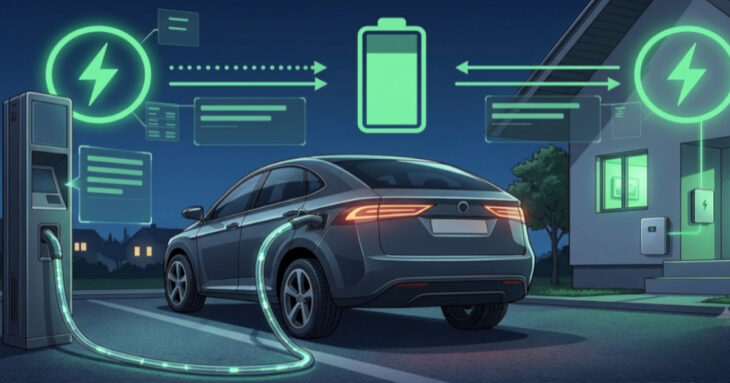
The Vehicle-to-Grid Dream: The Race to Unlock America’s Idle EVs
Electric vehicles sitting idle in American driveways are quietly becoming one of the most underutilized assets on the power grid, and a race among major automakers to change that is now fully underway.
The International Energy Agency projects 250 million EVs will be on roads globally by 2030. If even a fraction of those can feed power back to the grid when demand peaks, the impact on grid stability and energy investment could be substantial.
General Motors alone points out that its 250,000-plus bidirectional-capable vehicles already on U.S. roads hold enough combined battery capacity to power roughly 120,000 average American homes for up to a week.
The underlying concept is straightforward. EV owners charge their batteries when electricity demand and prices are low, then discharge stored power back to the grid during peak periods, earning money in the process. In theory, every EV on the road could one day function as a distributed power resource.
GM is currently making the most aggressive push. Last week, the company activated vehicle-to-grid (V2G) capability for its GM Energy customers through a software update, putting 12 bidirectional-capable models into play. Two utility partnerships are already live: a pilot with Michigan’s DTE Energy using 30 GM employees as test participants, and a collaboration with PG&E targeting 52,000 GM EVs enrolled in grid-balancing programs in Northern California by 2030.
Ford, however, moved first. The F-150 Lightning was among the earliest bidirectional-capable vehicles on the market, and Ford partnered with Maryland utility BGE and solar provider Sunrun to operate what was billed as the nation’s first residential V2G distributed power plant.
Tesla has commercial programs running today as well. Its Cybertruck Powershare system is active in Texas through partnerships with CenterPoint and Oncor, and PG&E’s V2X program in California also supports Tesla vehicles.
Beyond the Detroit automakers, Kia and Hyundai collaborated with UC Irvine researchers on a multi-year vehicle-to-home pilot in six Southern California homes, while the Kia EV9, Volvo EX90, and Polestar 3 all now support bidirectional charging in the U.S. market.
Despite the momentum, shared technology and charging equipment standards remain in early stages, and corporate priorities are shifting. Ford has moved toward selling large stationary battery systems, formally launching a Ford Energy subsidiary in May 2026.
The U.S. has nearly 3,000 regional electric utilities, and each must individually negotiate with automakers and establish customer incentive programs before V2G can scale meaningfully.
GM Energy says consumer awareness remains the primary bottleneck — a reminder that even the most capable technology stalls without the infrastructure and public understanding to support it.

Much of the World Is Building in the Wrong Places, and Now We Can Track It
Urban environments cover just 0.6% of Earth’s land surface yet house more than 57% of the global population, a share projected to reach 68% by 2050 according to UN data. Much of that growth is happening in places that carry serious physical risk, with new development increasingly concentrated in areas exposed to flooding, extreme heat, seismic hazards, land subsidence, and cyclones. Understanding exactly where and how fast that is happening has, until now, been difficult to track in real time.
The World Settlement Footprint (WSF) Tracker, unveiled at the World Bank headquarters in Washington, D.C., is designed to change that. Developed jointly by the German Aerospace Center and MindEarth, and co-designed with the European Space Agency and the World Bank, the platform draws on Copernicus Sentinel mission satellite data to map settlement growth at 10-meter resolution with updates every six months.
Covering July 2016 through January 2026, the WSF Tracker moves beyond static snapshots to provide a near-continuous view of how cities and settlements are evolving and what hazards those new settlements face.
What the data reveals is alarming. In Hanoi, significant suburban expansion over the past decade has pushed new construction specifically into the zones where a one-in-100-year flood event would run deepest, not merely flood-prone areas in general, but the most dangerous ones.
In Xi’an, in China’s Shaanxi Province, areas developed over the past decade spatially overlap with zones projected to face elevated ground subsidence risk by 2040, meaning infrastructure being built today may be sinking within 15 years.
In Goma, in the Democratic Republic of the Congo, the tracker reveals, for the first time at high resolution, a decade of continuous settlement expansion in one of the world’s most geologically and geopolitically volatile cities.
New Cairo offers a different but equally striking picture. Its desert expansion on the eastern edge of Egypt’s capital is so geometrically distinctive that it has been called “Egypt’s new city in the desert,” a massive settlement built from essentially nothing over a single decade.
These findings echo what the World Bank had already begun to observe using an earlier version of the tool. The rapid expansion of informal settlements in flood-prone areas across low- and middle-income countries is an especially concerning trend. The WSF Tracker now gives planners the data resolution and update frequency to act on it.

Meet Emaar Properties and Its New $54 Billion Project
In Dubai, one developer stands above them all: Emaar Properties. The company is the largest real estate developer in Dubai and one of the largest developers in the Middle East, with a presence in 36 markets across the region and beyond.
Emaar is best known as the developer behind some of the world’s most recognizable urban landmarks. Its most famous project is the Burj Khalifa, the world’s tallest building. Beyond that, Emaar developed Downtown Dubai, often called “The Centre of Now,” which is home to the Burj Khalifa, the Dubai Mall, and the Dubai Fountain. The Dubai Mall is the largest shopping mall in the world by total area. Other major projects in its portfolio include Dubai Marina, Dubai Hills, and Emaar Beachfront.
The company is also known for its master-planned communities that function almost as self-contained cities, combining residential, retail, hospitality, and entertainment.
Dubai ruler Mohammed bin Rashid Al Maktoum and the UAE’s sovereign wealth fund, the Investment Corporation of Dubai, are its two largest shareholders.
Now Emaar is preparing to launch what it describes as its most ambitious project yet: a $54 billion mixed-use urban district in Dubai designed to house nearly 150,000 residents.
The development will span more than 4.5 million square meters, encompassing residential towers, villas and mansions, Grade-A offices, retail, luxury hospitality, and cultural amenities. A high street spine and grand boulevard will serve as the district’s social and retail axis. At the pinnacle sits an exclusive gated villa enclave with five and six-bedroom residences, private gardens, and water features. Residential towers will frame a skyline oriented toward the Burj Khalifa, Burj Al Arab, and Palm Jumeirah.
The project is built around the 20-minute city model, with schools, healthcare, mosques, and retail all within walking distance. It will also feature proposed metro connectivity, EV-friendly pathways, and app-integrated community management, alongside parks, community lagoons, lakes, and a central district park with sports courts, event lawns, splash parks, and outdoor wellness zones.
The masterplan is divided into five zones: a Business Hub, Urban District, Young Families Cluster, Family Living Zone, and exclusive villa enclave. The project’s name and location have not yet been disclosed. No timeline, phasing structure, or financing plan has been announced.

China Is Building the World’s Most Remarkable Water Network
China continues to expand the world’s largest and most comprehensive water infrastructure system, a dual-purpose network designed both to deliver water to its population and to move freight across a continent-sized economy.
The foundation of that system is extraordinary in scale. China possesses over 128,000 kilometers of navigable waterways, an interconnected system of mega-canals, and over 95,000 reservoirs.
During the 14th Five-Year Plan, which was completed last year, the country invested over $800 billion in water conservancy. In that period, 181 major water conservancy projects broke ground, and the national water network expanded to cover 80 percent of China’s land area.
On the water access side, the infrastructure has delivered measurable results. The South-to-North Water Diversion Project channels fresh water from the Yangtze River basin to arid northern regions, including Beijing and Tianjin, and now serves as a stable water source for 195 million people. Rural tap water coverage reached 96 percent by the end of the planning period. Irrigated farmland now exceeds 70 million hectares.
Notably, Chinese officials report the country has achieved zero growth in total water consumption even as its economy and crop harvests have continued to grow. Water consumption per 10,000 yuan of GDP fell 20 percent, and water consumption per 10,000 yuan of industrial output dropped 25 percent.
On the navigation and trade front, China’s waterways have become a vital logistics backbone, connecting inland manufacturing centers with coastal ports. The 6,300-kilometer Yangtze River is at the heart of that network, but growing demand is pushing the system beyond its intended limits. Annual cargo throughput at the Three Gorges Dam reached 173 million tons in 2025—nearly double its original design capacity. To relieve the bottleneck, China recently broke ground on an $11 billion expansion that will effectively create a “water staircase” around the world’s largest dam. The project features a 6,680-meter, five-stage ship lock system designed to increase annual capacity to 336 million tons. Construction is expected to take approximately nine years.
Meanwhile, the $10 billion Pinglu Canal in Guangxi, the first river-to-sea canal built since the founding of the People’s Republic of China, is nearing its September inauguration. The 134-kilometer waterway will accommodate vessels up to 5,000 tons and cut freight routes to Southeast Asia by more than 500 kilometers. China’s waterway network for large freight vessels is projected to grow from 16,000 to 25,000 kilometers by 2035.
Big Deals
- Scion acquires Student Quarters for $1.5B to expand national student housing portfolio.
- Newmark arranges $975M in financing for data center in Northern Virginia.
- Kennedy Wilson and APG form €2B residential JV to develop private rental housing in Ireland.
- David Werner buys Midtown Manhattan tower with a $250M loan from JPMorgan.
- India-based rooftop solar startup SolarSquare Energy raises $55M.
- Prologis acquires Broward County, FL, industrial park for $352M.
- Integritas and Kriss Capital provide a $220M construction loan for 56-story New Jersey tower.
- Exponent Energy raises $21M to expand its Indian rapid EV charging network.
- Cypress Creek closes $3.5B in financing for large solar-plus-storage project in Arkansas.
Extra Reads
- OpenAI in talks to lease 10 GW Ohio data center with backing from Nvidia in $500B deal.
- Saudi government to spend $16B on cancelling parts of troubled Neom project.
- Genting plans $19B smart city project in Malaysia’s Johor Economic Zone.
- Seattle light rail shatters national ridership records with 155,000 daily rides.
- Sky Innovo launches $2B New Cairo mixed-use megaproject.
- More cities are embracing AI permitting systems. HUD funding is available for them.
- Delhi’s mega-region plan: eight new cities, faster connections.
- KKR launches $10B platform to build AI infrastructure.
- St. Louis advances $9.2B freight infrastructure strategy.
- AI-related water consumption could equal the annual domestic needs of 1.3B people by the end of the decade.
- EU launches historic unified strategy for island and coastal urban planning.
- Chile becomes home to the largest battery plant in North or South America.
- Seattle enacts year-long ban on new AI data centers.
- NYC’s Mayor releases “Block by Block” plan, a sweeping blueprint to tackle the city’s housing crisis.