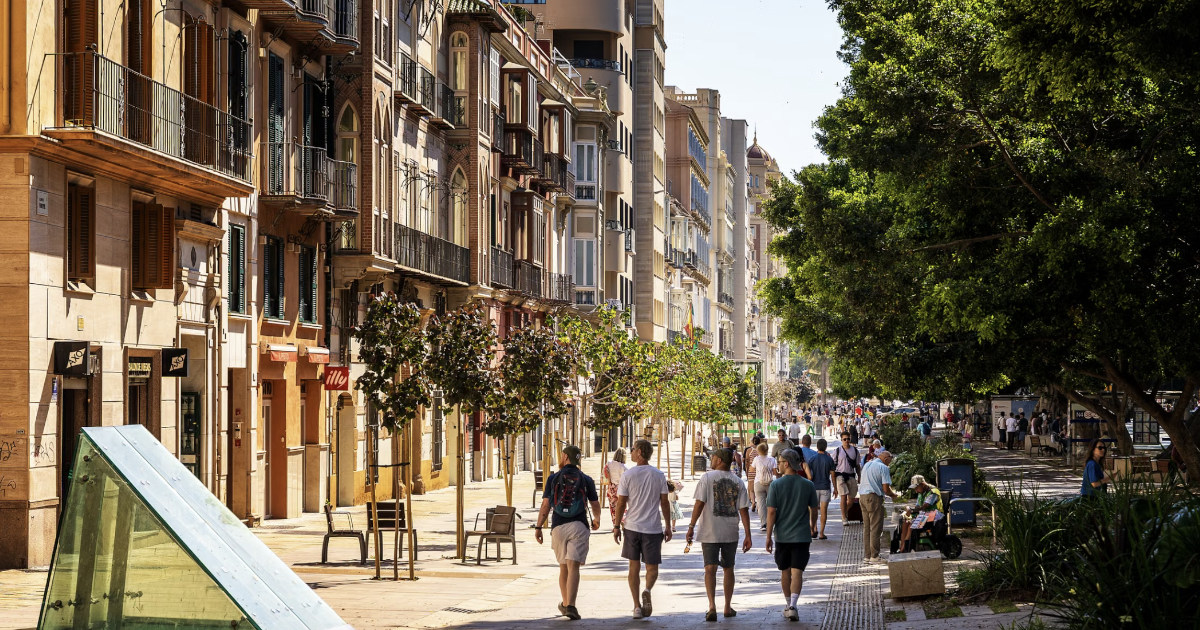
Putting apartments above retail does not automatically create a 15-minute neighborhood — a place where daily necessities and services, from groceries to schools, healthcare and parks, are all reachable within a 15-minute walk from home.
Walkability is not simply a design problem. It is a real estate problem.
Housing has to put enough customers near businesses. Retail space has to fit businesses residents actually use. Streets and transit have to connect those uses. And the economics have to work well enough for businesses to remain.
Put another way, restaurants and coffee shops make a project feel urban, but meeting daily needs requires supermarkets, pharmacies and healthcare — each with very different space requirements.
Three projects show how differently that equation can be assembled — at the scale of a policy-led transit corridor, a single ground-up development and a citywide infrastructure network.
Arlington Concentrated the Market Around Transit
Arlington did not try to make the entire county equally dense.
Its planning strategy concentrated higher-density development around Metro stations while preserving lower-density residential neighborhoods farther away. Within the Rosslyn-Ballston corridor, density generally peaks around five stations — Rosslyn, Courthouse, Clarendon, Virginia Square and Ballston.
The result is a large concentration of potential customers, workers and destinations within one transit corridor.
As of Arlington County’s FY2024 Planning Corridors Development Update, published in December 2024, the Rosslyn-Ballston corridor contained 38,730 completed residential units, 24.1 million square feet of office space and nearly 3.6 million square feet of retail. Another 1,120 residential units were under construction and 5,940 had been approved.
The point is not that density automatically creates walkability.
Density creates a larger nearby market. Transit and street connectivity determine how much of that market businesses and residents can actually reach.
That distinction matters for developers underwriting mixed-use projects. A few hundred apartments above several storefronts may look urban without creating enough demand to support a useful mix of businesses.
Arlington’s model works at corridor scale rather than building scale.
This is central to how a 15-minute city actually functions: as a market assembled across a corridor, not manufactured inside a single building.
Culdesac Removed Parking — Then Had to Build a Market
Culdesac Tempe tests the equation at a much smaller scale.
The 17-acre Arizona development was designed around residents living without private cars. Instead of building conventional resident parking, Culdesac placed housing, pedestrian space and commercial uses next to Valley Metro light rail.
The project is no longer only a plan.
Culdesac currently reports more than 350 residents and 23 local businesses operating in the neighborhood, with more than 1,000 residents planned at completion.
Those numbers are important because the commercial component depends on more than attractive urban design. Businesses need customers.
Culdesac is effectively building both sides of the market at once: adding residents who can patronize local businesses while recruiting businesses that make car-light living more practical.
But the evidence has limits.
Culdesac has not publicly released the kind of detailed retail-sales, storefront-vacancy or resident travel data that would allow an independent assessment of whether the completed neighborhood will economically outperform a conventional mixed-use development.
And with roughly one-third of its planned resident population currently in place, the project is still developing.
That makes Culdesac useful as an operating experiment, not yet proof that removing parking guarantees successful retail.
Its location on light rail is also critical. A development does not need to contain every destination if residents can reach destinations elsewhere without driving.
Atlanta Shows What Connectivity Can Do to Land Value
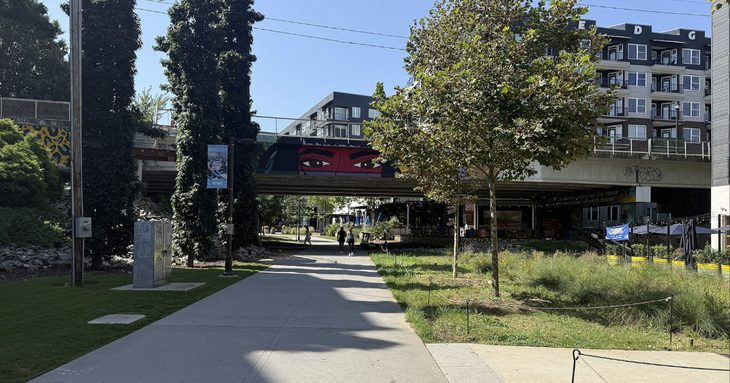
Atlanta’s BeltLine moves the experiment from a project to a network.
The BeltLine is building a 22-mile loop of trails, parks and planned transit connecting more than 45 neighborhoods. Rather than requiring every development to contain every daily destination, the infrastructure links multiple residential and commercial districts.
The economic response has been substantial.
In May 2026, Atlanta BeltLine reported that nearly $1 billion in public infrastructure investment had helped catalyze $14.2 billion in private investment across neighborhoods adjacent to the corridor.
That is the upside of connectivity.
The complication is what happens when improved access makes surrounding real estate more valuable.
Atlanta BeltLine reported 4,425 affordable housing units created or preserved within its Tax Allocation District by the end of 2025 — 79% of its goal of 5,600 units by 2030.
The BeltLine therefore illustrates both sides of 15-minute neighborhood economics.
Infrastructure can connect residents to more destinations and make surrounding development more attractive. But when that accessibility becomes valuable, preserving affordable access to the neighborhood becomes another real estate problem.
Underwrite the 15-Minute Neighborhood, Not Just the Building
Arlington, Culdesac and Atlanta operate at radically different scales, but they point toward the same conclusion.
A mixed-use building is not necessarily a mixed-use neighborhood.
For developers, that distinction should enter underwriting before the site plan is finished: how many households and workers actually live within walking distance, which daily-use businesses that population can support, and what rents those businesses can afford to pay.
Cities can apply the same test to zoning changes, infrastructure investments and development incentives, rather than approving projects based on unit counts and retail square footage alone.
Instead of asking only how many apartments and how much retail a project contains, an RFP or development agreement can ask what market supports that retail and how residents will reach the destinations the project does not provide.
That is the real estate test for a 15-minute neighborhood.
Before breaking ground, developers should be able to answer two questions: Who will support the businesses downstairs? And how will the people upstairs reach everything that isn’t there?